May is one of those months that makes you realize how quickly time moves.
My 8th grader, Amelia, is about to graduate middle school. My junior, Ella, just wrapped up her AP exams and has one year left before college.
Which is completely ridiculous, because I’m pretty sure they were both learning to ride bikes about 15 minutes ago.
Time flies.
And investing has a funny way of working the same way.
Day to day, it can feel like nothing is happening. Or worse, it can feel like everything is going wrong. Inflation pops up. Interest rates move higher. Oil prices swing. The Fed changes leadership. One kid loses her water bottle and the other doesn’t know where her soccer cleats are. Meanwhile, the Giants — who it seems like just yesterday were winning World Series championships — lose in spectacular fashion again.
Then you zoom out and realize the market has been quietly compounding through all of it.
And in May, it was not so quiet.
May was, to use the technical term, a kick-ass month. (Pardon my French.)
May in a Nutshell
The S&P 500 gained 5.1%.
The Nasdaq jumped 8.4%.
The Dow rose 2.8%.
All three major U.S. indexes finished the month at new all-time highs. The S&P 500 also crossed 7,500 for the first time.
That happened despite plenty of reasons to worry:
- Long-term interest rates moved higher
- Inflation stayed sticky
- Oil prices were still elevated, even after falling from April levels
- The Fed got a new Chair
- First quarter GDP was revised lower
In other words, the market did what it often does.
It climbed the wall of worry.
Again.
Are All-Time Highs a Warning Sign?
This is usually the point where people start to get nervous.
The market hits a new high and the natural reaction is:
Did I miss it?
Is this a bad time to invest?
Are we due for a pullback?
Totally fair questions.
But as one of my favorite financial writers Sam Ro recently pointed out, the fact that some major bear markets began after all-time highs does not mean all-time highs usually lead to major bear markets. That is an important distinction. The market would not have compounded higher over decades if every new high were some kind of warning siren. In fact, analysts from the S&P Dow Jones Indices has found that the S&P 500 has recorded more than 1,000 all-time-high closes in its live history and more often than not, another high followed soon after.
Said another way:
All-time highs are not a sell signal.
They are often just what long-term progress looks like.
That does not mean the ride is smooth from here.
Sam also makes the important point that good returns after all-time highs have still come with volatility. Markets can be at record highs and still pull back 5%, 10% or more along the way. Those two things are not in conflict. That is just investing.
So the question is not:
“Is the market too high?”
The better question is:
“Is my portfolio built so I can stay invested when the next normal bout of volatility shows up?”
Because that is where the real work happens.
Not at the all-time high.
After it.
Remember April?
Last month, I wrote that markets have a habit of doing the exact opposite of what feels comfortable.
They pull back just enough to make you question things, then recover just fast enough to make it hard to get back in.
May was that idea with a highlighter over it.
In April, the market had already bounced back sharply from earlier volatility. The S&P 500 gained 10.4%, the Nasdaq rose 15.3% and small caps jumped more than 12%.
Then May came along and added another strong month on top of it.
That is the part investors miss when they try to get cute.
The recovery rarely waits until everyone feels better.
By the time the headlines calm down, a lot of the move may already be behind us.
This Is Why I Sound Like a Broken Record
In April, I also wrote about the Vanguard study showing investors there generated roughly $5 trillion in gains over the past decade.
The takeaway was not that those investors were brilliant market timers.
It was that they did not interrupt a good strategy.
They stayed invested.
They kept adding money.
They paid low fees.
They owned broadly diversified portfolios.
Nothing fancy.
And yes, that probably sounds familiar because this is the same blueprint we use.
Your portfolio is not designed to:
- Time every move
- Avoid every downturn
- Chase whatever is working this month
It is designed to:
- Stay invested through volatility
- Capture growth across different parts of the market
- Let earnings and time do the heavy lifting
It may not be exciting.
But months like May are exactly why it works.
The Receipts Were Pretty Good
One of the most encouraging parts of May was that the rally was not just one narrow story.
Yes, large technology stocks helped lead the way. But gains were broader than in some previous years. International developed markets rose 2.6% and emerging markets gained 9.5%. Even bonds eked out a positive month despite pressure from higher rates.
That matters.
Because diversified portfolios are not built around the idea that every piece works every month.
They are built around the idea that different pieces work at different times.
Sometimes growth leads.
Sometimes international leads.
Sometimes bonds provide income.
Sometimes energy helps.
Sometimes the boring parts do their job quietly in the background.
The goal is not to guess which piece wins next.
The goal is to own enough of the right pieces so you do not have to.
Earnings Still Matter Most
Here is the part that keeps me optimistic about markets in a way I simply cannot be about the Giants right now.
With the Giants, optimism is mostly emotional.
With markets, optimism has a foundation.
Companies grow. Earnings expand. Innovation continues.
The May commentary made the same point: corporate earnings have continued to grow at a solid pace, forecasts point to further growth and strong earnings have helped keep valuations relatively stable despite stocks reaching new highs.
That does not mean stocks are cheap.
It does not mean there will not be pullbacks.
It just means the move higher has not come out of nowhere.
There is an engine underneath it.
There Is Always Another Thing
Of course, it would not be investing if everything looked perfect.
Rates moved higher in May, with the 30-year Treasury yield briefly reaching 5.18%, its highest level in nearly two decades, before settling back below 5%. Higher rates can pressure stock valuations and raise borrowing costs, but they also mean bonds are finally offering more income than they have in years.
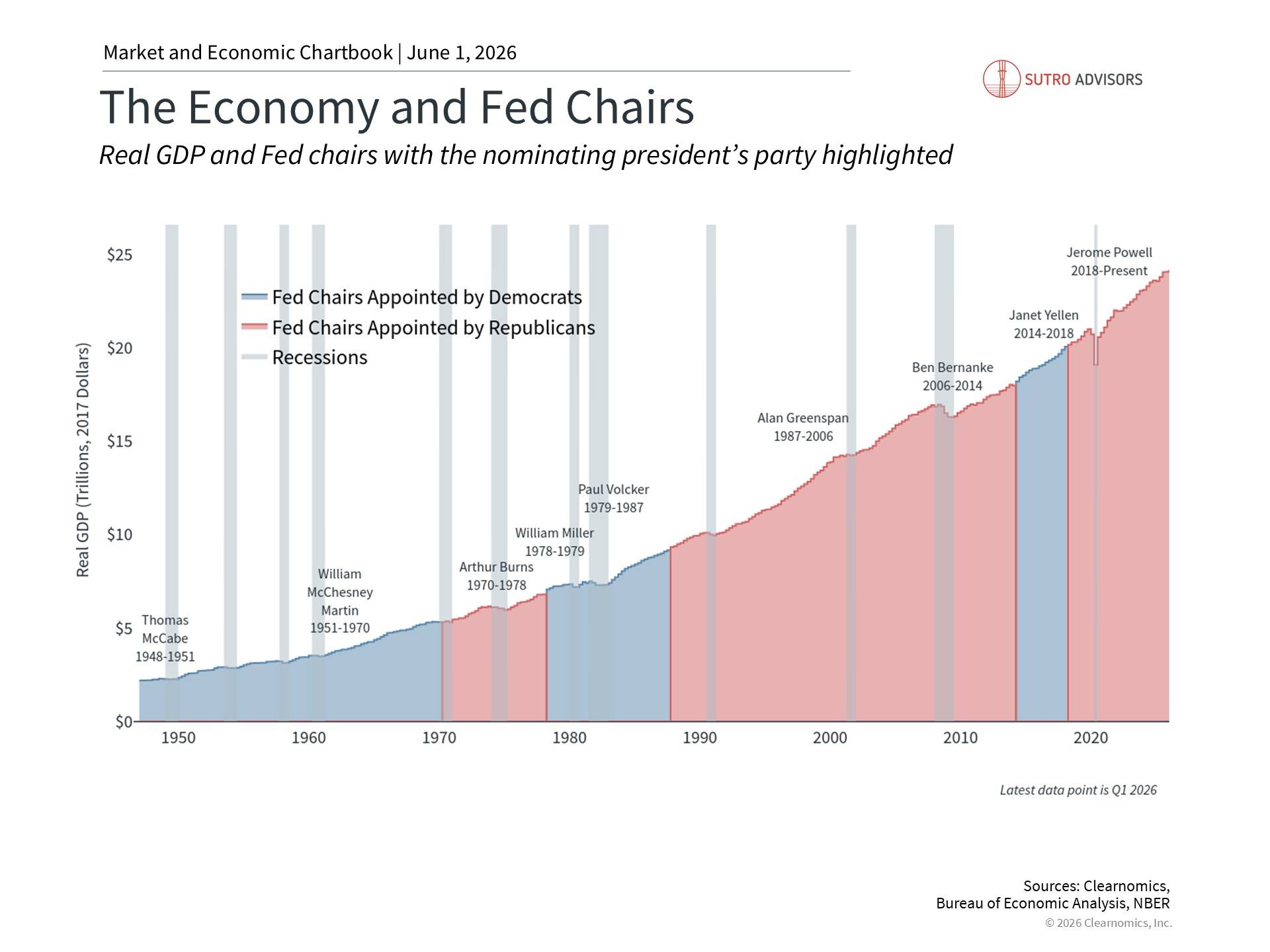
The Fed also got a new Chair, with Kevin Warsh taking over from Jerome Powell. That brings plenty of questions, but history gives some perspective. The economy has grown through many different Fed Chairs, political backdrops and policy environments. Long-term drivers like earnings growth, innovation and productivity tend to matter more than who is sitting at the podium.
There is always something.
Inflation.
Rates.
Oil.
The Fed.
Geopolitics.
Valuations.
Elections.
And now, as if my sports life needed another problem, the Rams traded for Myles Garrett, a two-time AP Defensive Player of the Year. So even my “at least football season is coming” coping mechanism took a hit this week.
Perfect.
But that is also the point.
Waiting for a world with no worries sounds reasonable.
It just means you will probably be waiting forever.
Meanwhile… Back to the Kids
I've found that it is nearly impossible to notice kids growing up day by day.
Then suddenly Amelia is graduating middle school and Ella has one foot out the door on the way to college.
Markets can feel the same way.
You do not always notice the compounding while it is happening. You notice the headlines. You notice the volatility. You notice the bad days.
Then one month like May comes along and reminds you that progress was happening the whole time.
Not every day.
Not in a straight line.
But over time.
The Bottom Line
May was a great month.
A really great month.
But it wasn't great because every problem disappeared.
It was great because investors who stayed invested were there to participate when the market moved.
That was the lesson in April.
That was the lesson from the Vanguard study.
And that was the lesson again in May.
Markets do not reward perfect timing.
They reward discipline.
Even when rates rise.
Even when headlines are loud.
Even when the Giants stink.
Even when the Rams decide to ruin my football optimism in June.
Time flies.
The plan works.
Stay invested.
Until next time, take good care!